
To Succeed in AI, You Need Less AI and More Human Connections
The fastest career transition in AI isn't a certification or a portfolio project. It's a conversation. Here's the framework I've used — and why human connection is still the most underrated career strategy.

There is a version of career advice that the AI industry is very good at selling right now. It goes something like this: the world is changing fast, AI is taking over everything, and the only people who will survive the transition are the ones who upskill fast enough. Take the certification. Build the model. Learn the framework.
I understand why that advice exists, and I'm not here to dismiss it entirely. I got one of the first AI certifications on my team at Deloitte back in 2019. Credentials matter. Skills matter.
But I keep watching something happen that the certification vendors don't talk about, and I think it's worth naming.
The Mistake I See Everywhere Right Now
As AI begins to make a meaningful impact on cybersecurity — and as security teams start grappling seriously with what it means to secure AI itself — I'm seeing more and more talented professionals put their heads down and grind. Learning the latest frontier model. Spending significant amounts of money on advanced degrees and certifications. Spending weekends building a portfolio project they're convinced will get them noticed.
Then they finish the course. They ship the project. They wait.
And they get passed over.
They can't figure out what went wrong. Every box looked ticked. They did everything the advice told them to do. And when the doors don't open — when the promotion doesn't come, when the role goes to someone else — they do what a lot of people do: they reach back out to whatever mentor, maybe the "AI mentor" tool again, or community helped them get started, looking for the missing piece.
The degree or certification wasn't the problem. The strategy was.
What Actually Works
Across my career at Deloitte and beyond, I've been genuinely fortunate to work with leaders who invested in my success. That's not something I take for granted, and it didn't happen by chance. What I learned — slowly, through years of working relationships — is that the people who move fastest in their careers are rarely the ones with the most impressive credentials. They're the ones who have made themselves genuinely useful to people who matter, and who have built relationships that are real rather than transactional.
I made the success of the people I worked with my genuine priority. Not as a tactic. Not to collect favours. Because I actually cared. And over time, that came back to me in ways I couldn't have designed or planned.
The relationship was the strategy. It still is.
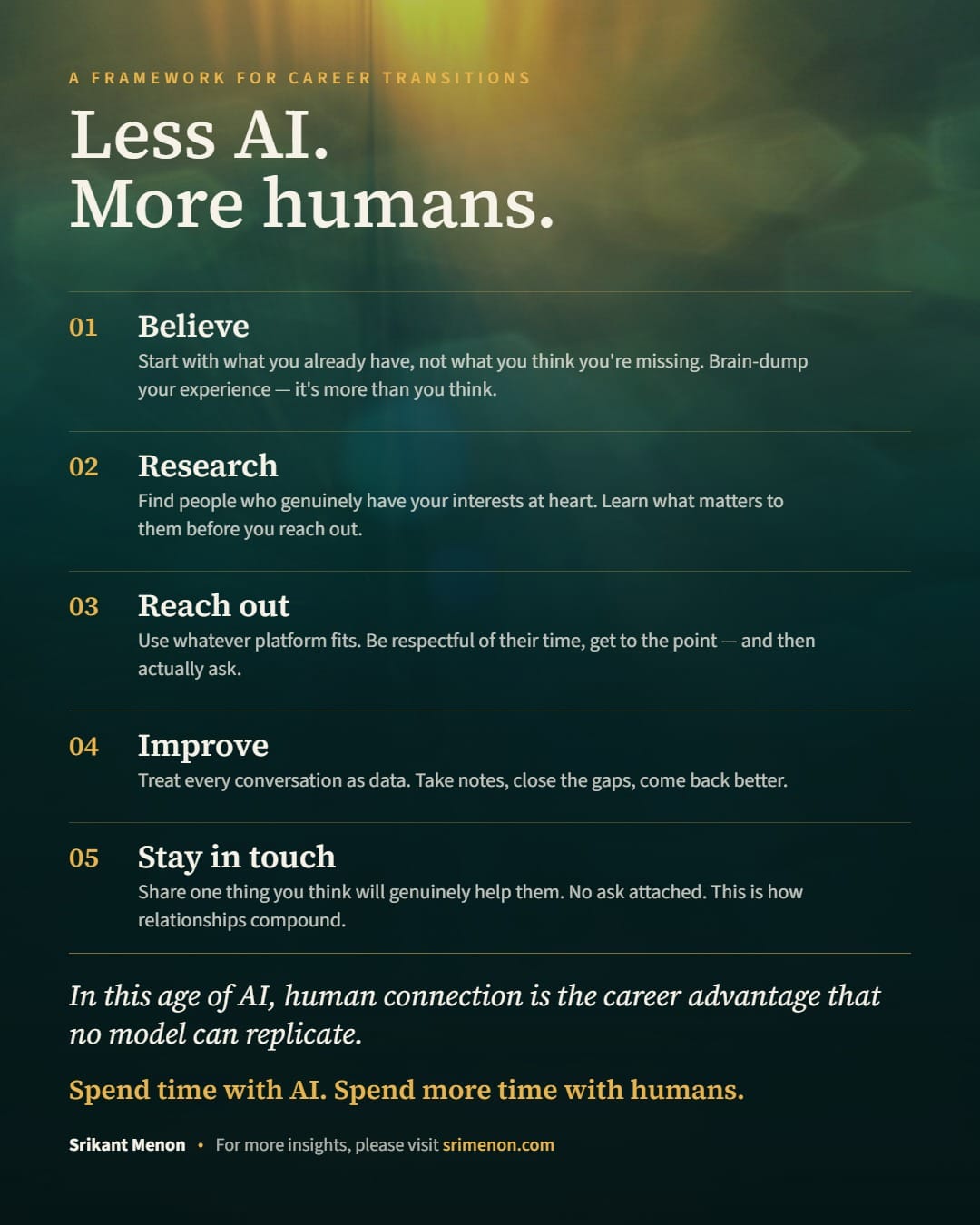
A Framework for Career Transitions Built on Human Connection
This isn't abstract advice. Here's the actual process I've used, and that I've seen work for others across career transitions in security, OT/IoT, AI, governance, and beyond.
Believe — Start with what you have, not what you're missing
The first step is internal, and it's the one most people skip. Before you research the certification options or draft the outreach email, do a complete brain dump of what you already bring. Your industry experience. The technologies you know. The problems you've solved. The teams you've led. The crises you navigated. The network you've spent years investing in. The community involvement, the leadership moments, the things that felt ordinary at the time but that other people in other roles would find genuinely valuable.
Write all of it down. No filter.
You will be surprised by what's already there. The reason this matters is that certifications and courses taken from a position of genuine self-awareness — "I know what I have, and I want to add this specific capability" — are additive. They build on a foundation. Certifications taken from a position of anxiety — "I need this because I'm not enough yet" — often don't land the same way because the anxiety is legible to the people you're trying to impress.
Know what you have. Then figure out what to add.
Research — Find the people worth reaching, and understand what matters to them
Make a list. Not a hundred people — a realistic list of people who you believe genuinely have your interests at heart. Former colleagues. Senior contacts who've seen you do good work. People whose careers you've followed and respected. Maybe someone you've met once who made an impression.
Before you reach out to any of them, do real research. What are they working on right now? What's the challenge their organization is trying to solve? Where is your experience — specific, concrete experience, not just your job title — actually useful to them?
This is not about manufacturing a reason to talk to someone. It's about being genuinely prepared to be useful, not just to be helped. The best conversations I've had across my career started with me knowing enough about the other person's situation to contribute something real, not just to ask for something.
Reach out — Ask clearly, and ask respectfully
Use whatever platform is appropriate — email, LinkedIn, Teams, a direct message if the relationship already exists. Be concise. Get to the point. Don't bury the ask in three paragraphs of preamble.
Practice what you want to say before you say it, especially for conversations that matter. First impressions are surprisingly durable, and the second impression — after someone has already decided you weren't quite ready — is much harder to make.
And then, actually ask. Ask for their perspective on the career transition you're considering. Ask for an introduction to someone they know in the space. Ask for their advice on a specific decision you're facing. Be direct about what you're trying to do.
In my experience, people genuinely want to help. That's not naivety — it's something I've seen consistently across different industries and cultures. But most people are waiting to be asked clearly and specifically. Vague conversations rarely produce useful outcomes because vague conversations don't give the other person a clear way to help you.
Improve — Treat every conversation as data
Take notes after every conversation. What did they say that surprised you? Where did you sense the conversation lose energy? What question did they ask that you weren't prepared for? What did they mention that you want to learn more about?
This is the step people skip because they're hoping each conversation will be the breakthrough. Occasionally one is. More often, your career transition happens through accumulated insight across many conversations, each one slightly better than the last. The people who treat this as a process — rather than a series of individual bets — tend to move faster, because each conversation makes the next one more valuable.
Stay in touch — Invest
Staying in a relationship doesn't mean following up every few weeks with another ask. It means occasionally — and genuinely — sending something you think will be useful to that specific person. An article relevant to a problem they mentioned. A connection to someone you know they'd benefit from meeting. A note when something you discussed came to fruition.
One relevant thing, no ask attached.
Relationships compound when they feel mutual, not extractive. The goal is to be the person someone is genuinely glad to hear from.
The Lesson
I am not arguing against AI skills. I am arguing against the idea that AI skills are a substitute for human relationships in building a career — because they are not, and the evidence is everywhere if you're watching.
The people I see move fastest in their AI careers right now are not always the ones with the most advanced technical skills. They are the ones who combined relevant experience and genuine curiosity with the willingness to be visible, to ask for help, and to invest in the people around them. The technical skills matter. The human skills matter more.
In this age of AI, human connection and authenticity are not soft supplements to a career strategy. They are the career strategy.
Spend time with AI. Spend more time with humans.