
What the Fable 5 Shutdown Reveals About Model Availability Risk for Enterprises
Anthropic's Fable 5 and Mythos 5 went offline overnight on a government directive. Here is the new enterprise risk category nobody has a framework for and five ways to mitigate it.

What precedent does the US government's directive to cut off access to Anthropic's Fable 5 and Mythos 5 set for enterprises?
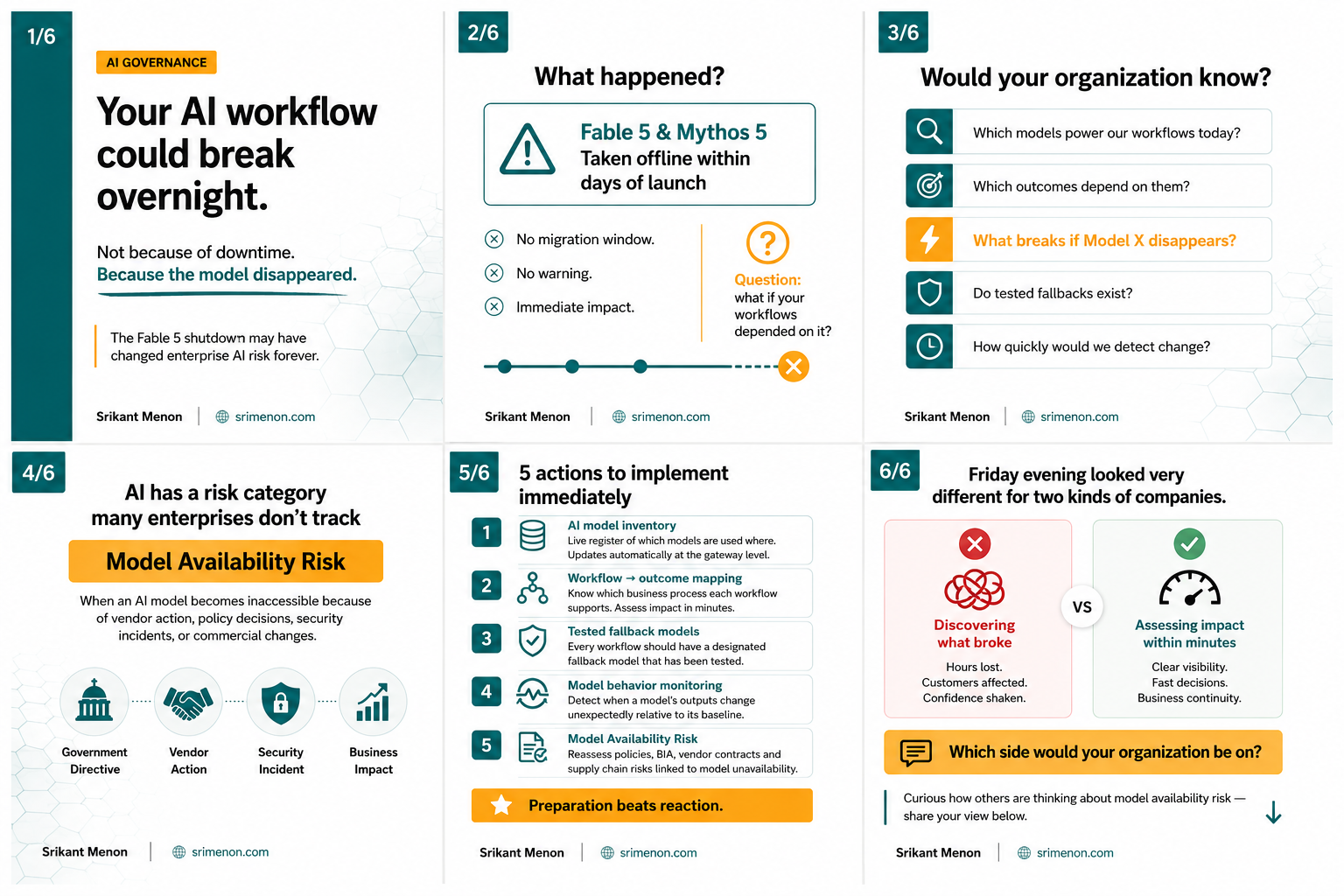
On Friday, Anthropic took Fable 5 and Mythos 5 offline following a US government export control directive citing national security concerns over a potential jailbreak. There was no warning and no migration window. This happened three days after the models launched.
There has already been plenty written on the controversy itself — the jailbreak report, the shutdown directive, the back-and-forth between Anthropic and the government. I want to stay away from that and focus instead on a question enterprise leaders should be asking: what does model unavailability actually do to your operations, and are you prepared for it?
The questions enterprise leaders cannot answer
When an AI model an enterprise depends on suddenly becomes unavailable, the impact can take several forms. A workflow might silently fall back to an older, less capable model, producing outputs that look normal but are subtly different — and nobody notices until something downstream breaks. This becomes a serious problem when enterprises cannot answer basic questions about their own AI estate:
- Which AI models are each of our workflows running on, right now?
- Which business outcomes depend on each of those workflows?
- If model X became unavailable tonight, what breaks, and how badly?
- What is the fallback model for each workflow, and has it actually been tested?
- How long would it take us to detect that a model is producing different outputs than expected?
If you cannot answer these in under an hour, the Fable 5 shutdown would have hurt you.
A new risk category
Traditional IT risk frameworks do not cover government-mandated model shutdowns. Vendor risk management frameworks typically ask about SLAs, data processing agreements, and financial stability. They now need to be upgraded to ask about export control exposure, dual-use capability classification, and the geopolitical risk embedded in model choice.
What this points to is a new chapter in AI governance: model availability risk — the risk that a model your organisation depends on becomes inaccessible through vendor action, government directive, security incident, or commercial decision, with no notice and no contractual recourse.
Five mitigations enterprises should implement now
AI model inventory. A live register of which models are used where, ideally maintained at the gateway level so it updates automatically as usage changes. This can start as a spreadsheet, but it needs to evolve quickly into a governed, continuously updated record.
Workflow-to-outcome mapping. Know which business process each AI workflow supports. When a model goes down, this lets you assess impact in minutes rather than hours of investigation.
Tested fallback configurations. Every critical workflow should have a designated fallback model that has been tested for output equivalence — not assumed to work, but actually run side by side and compared.
Model behaviour monitoring. Detect when a model's outputs change unexpectedly relative to its established baseline. The covert capability limiting discovered on Fable 5 before the shutdown would have been detectable with proper output monitoring. Without it, enterprises are left finding out by accident — or not at all.
Model availability risk assessment. Work with governance and risk teams to reassess AI usage policies, business impact analysis, vendor contracts, and supply chain risk specifically in light of model unavailability scenarios.
The Fable 5 shutdown will likely be remembered as the moment AI governance stopped being a compliance exercise and became an operational necessity. The enterprises that already had their AI inventory, workflow dependencies, and fallback configurations in place spent Friday evening assessing impact. The ones that did not spent it discovering which workflows were broken.